How Is PF Calculated? Employee and Employer EPF Contribution Explained
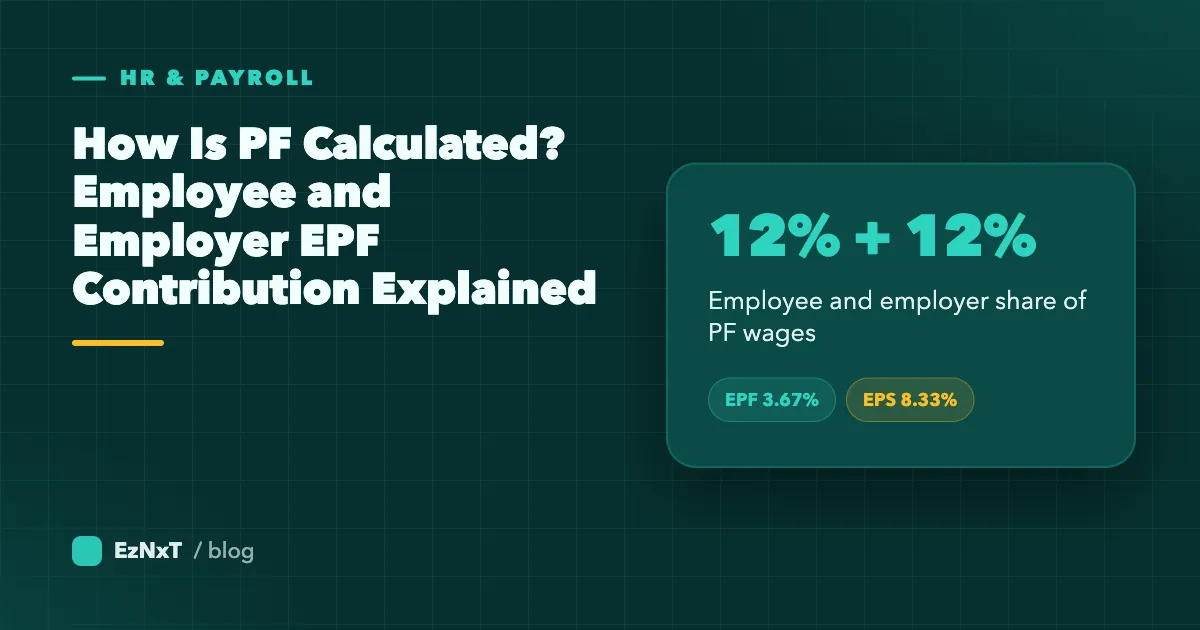
Quick answer: how is PF calculated? The employee contributes 12% of PF wages (basic pay plus dearness allowance). The employer also contributes 12%, split into 8.33% for the Employees’ Pension Scheme (EPS), capped at ₹1,250 a month, and the rest to the employee’s EPF account. The employer also pays EDLI insurance and EPFO admin charges on top.
Provident Fund is the deduction employees ask about most, because it affects take-home pay today and retirement savings later. The rules are simple once you separate three things: the wage base, the employee share and how the employer share is split.
Step 1: find the PF wage base
PF is calculated on “PF wages”: basic pay plus dearness allowance (and retaining allowance, if any). HRA, conveyance and most special allowances are excluded. Under the new Labour Codes, a uniform definition of wages applies: if excluded allowances exceed half of total pay, the excess is added back. Our guide to the 50% wage rule covers this in detail.
The statutory wage ceiling is ₹15,000 a month. Employers may contribute on the ceiling (₹15,000) or on actual PF wages above it. Many small businesses restrict contributions to the ceiling.
How is PF calculated: the contribution split
| Component | Rate | Paid by | Goes to |
|---|---|---|---|
| Employee contribution | 12% of PF wages | Employee (deducted from salary) | EPF account |
| Employer contribution to EPS | 8.33% of wages up to ₹15,000 (max ₹1,250) | Employer | Pension scheme |
| Employer contribution to EPF | 12% minus the EPS share | Employer | EPF account |
| EDLI | 0.5% of wages up to ₹15,000 (max ₹75) | Employer | Insurance scheme |
| Admin charges | 0.5% of PF wages (subject to EPFO minimums) | Employer | EPFO |
Worked example 1: PF wages of ₹15,000
- Employee PF: 12% × 15,000 = ₹1,800
- Employer EPS: 8.33% × 15,000 = ₹1,250
- Employer EPF: 1,800 − 1,250 = ₹550
- EDLI: 0.5% × 15,000 = ₹75
- Admin charges: 0.5% × 15,000 = ₹75
The employee’s EPF account receives ₹1,800 + ₹550 = ₹2,350 a month. The total employer cost is ₹1,800 + ₹75 + ₹75 = ₹1,950.
Worked example 2: PF wages of ₹25,000
| Contribution on ceiling (₹15,000) | Contribution on actual (₹25,000) | |
|---|---|---|
| Employee PF | ₹1,800 | ₹3,000 |
| Employer EPS | ₹1,250 | ₹1,250 |
| Employer EPF | ₹550 | ₹1,750 |
| Monthly credit to EPF account | ₹2,350 | ₹4,750 |
The EPS share stays at ₹1,250 either way, because pension contributions are calculated on wages up to ₹15,000. Contributing on actual wages lowers take-home pay but raises savings. Decide the policy once and apply it consistently. See how this flows into take-home pay in in-hand salary from CTC.
When PF has to be deposited
Contributions for a month are deposited through the EPFO employer portal (ECR) by the 15th of the following month. Late deposits attract interest and damages, so build the deadline into your payroll calendar. Whether your business must register at all is covered in PF applicability and the employee limit.
Common PF calculation mistakes
- Calculating PF on gross salary instead of PF wages.
- Putting more than ₹1,250 a month into EPS for an employee.
- Forgetting to prorate PF wages for unpaid leave days.
- Changing between “ceiling” and “actual” contributions mid-year without a documented policy.
Frequently Asked Questions
Is PF calculated on basic or gross salary?
On PF wages: basic pay plus dearness allowance (and retaining allowance). Allowances such as HRA are excluded, but under the Labour Codes excluded allowances above 50% of total pay are added back to wages.
What is the maximum employer PF contribution?
If contributions are restricted to the ₹15,000 wage ceiling, the employer’s 12% share is ₹1,800 a month (₹1,250 to EPS and ₹550 to EPF), plus EDLI and admin charges. Employers can choose to contribute on higher actual wages.
Can an employee contribute more than 12%?
Yes. Through Voluntary Provident Fund (VPF), an employee can contribute more than 12%. The employer is not required to match the extra amount.
Who decides the PF interest rate?
EPFO declares the EPF interest rate for each financial year after approval by its Central Board of Trustees and the government. Check the current rate on the EPFO website.
Does EzNxT calculate PF automatically?
EzNxT payroll lets you set PF deduction rules on each salary structure, calculates the employee and employer amounts and shows them on every payslip. Statutory filing on the EPFO portal is still done by you or your CA.
See EzNxT payroll software for salary structures, PF and ESI deductions and payslips.