How Is Gratuity Calculated? Formula, Eligibility and Examples
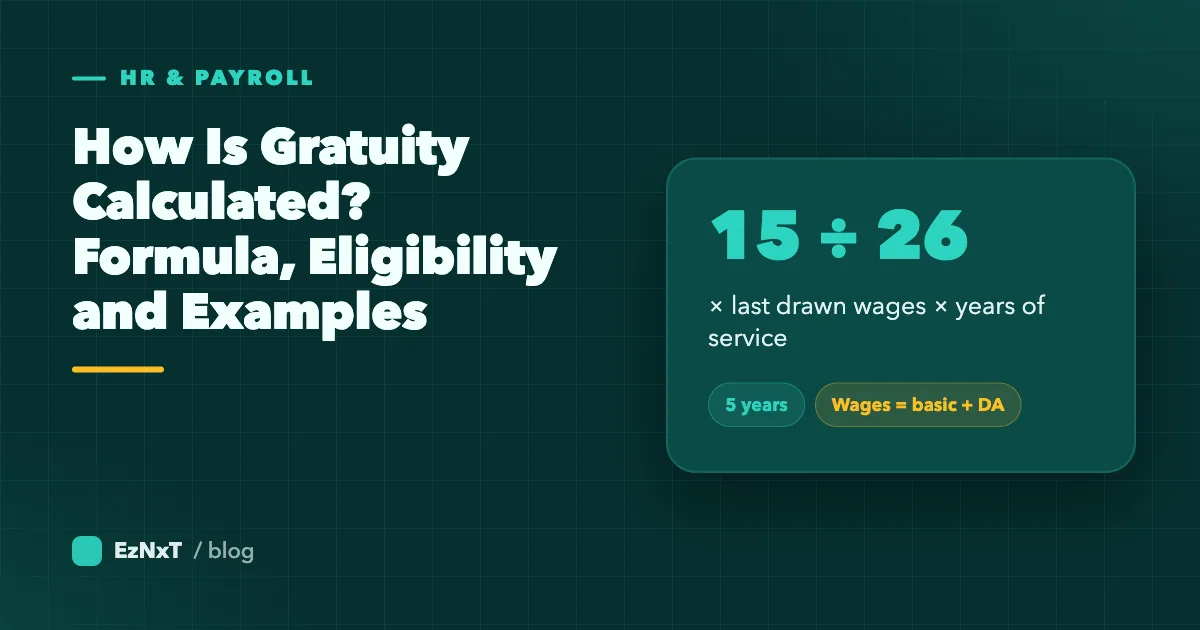
Quick answer: how is gratuity calculated? For employers covered by gratuity law, gratuity = 15 ÷ 26 × last drawn monthly wages × completed years of service. Wages means basic pay plus dearness allowance. Employees usually become eligible after five years of continuous service; fixed-term employees qualify after one year under the Labour Codes. The tax-free and payable limit is ₹20 lakh.
Gratuity is a lump sum an employer pays when an employee leaves after long service, retires, or in case of death or disablement. Since the four Labour Codes came into force on 21 November 2025, gratuity is governed by the Code on Social Security, which carries forward the familiar formula. Here is how the numbers work.
Gratuity calculation formula
| Part of the formula | What it means |
|---|---|
| 15 | 15 days of wages for each completed year of service |
| 26 | Working days in a month (a month’s wages ÷ 26 = one day’s wages) |
| Last drawn wages | Basic pay + dearness allowance for the last month (see the 50% wage rule below) |
| Completed years | Years of continuous service; a final part year of more than six months is rounded up |
For employees whose employer is not covered by gratuity law, companies that pay voluntarily often use half a month’s wages per year (15 ÷ 30) instead. Follow your policy or employment contract.
How is gratuity calculated: worked examples
- 7 years of service, ₹30,000 last drawn wages: 15 ÷ 26 × 30,000 × 7 = ₹1,21,154
- 5 years 8 months, ₹40,000: service rounds up to 6 years → 15 ÷ 26 × 40,000 × 6 = ₹1,38,462
- 10 years 4 months, ₹50,000: service counts as 10 years → 15 ÷ 26 × 50,000 × 10 = ₹2,88,462
Who is eligible for gratuity?
- Establishments: gratuity law applies to establishments with 10 or more employees. Once covered, they remain covered.
- Permanent employees: after five years of continuous service, on resignation, retirement or termination.
- Fixed-term employees: on a pro-rata basis after one year of service under the Labour Codes. Read more in our Labour Codes guide.
- Death or disablement: the minimum service condition does not apply; gratuity is paid to the employee or nominee.
The 50% wage rule and gratuity
Under the Labour Codes’ uniform definition of wages, if allowances excluded from wages add up to more than half of total pay, the excess is added back. A salary structure with a small basic pay and a large special allowance can therefore have a higher gratuity base than before. Check your structures. Our in-hand salary from CTC guide shows a 50%-basic structure.
Limits, timelines and tax
- Maximum: the statutory ceiling on gratuity payable is ₹20 lakh, as currently notified.
- Payment: employers should pay within 30 days of the gratuity becoming payable; delays attract interest.
- Tax: gratuity received by private-sector employees is tax-exempt up to the notified limit (₹20 lakh), and fully exempt for government employees. Confirm the current rules on the Income Tax Department’s website.
- Provision: many employers budget gratuity at about 4.81% of basic pay (15 ÷ 26 ÷ 12) inside CTC.
Frequently Asked Questions
What is the formula for gratuity calculation?
Gratuity = 15 ÷ 26 × last drawn wages (basic + DA) × completed years of service, for employers covered by gratuity law.
Is gratuity paid before five years of service?
For permanent employees, generally only after five years, except on death or disablement. Fixed-term employees become eligible on a pro-rata basis after one year under the Labour Codes.
Is 4 years and 7 months counted as 5 years for gratuity?
A part year of more than six months is rounded up when calculating the amount, but whether eligibility (five years) is met in borderline cases depends on how continuous service is counted. Ask your legal adviser for specific cases.
What is the maximum gratuity amount?
The statutory ceiling is currently ₹20 lakh. Employers can pay more voluntarily, but amounts above the tax-exempt limit are taxable.
Is gratuity part of CTC?
Many employers include a gratuity provision in CTC, but it is not paid monthly. It is paid only when the employee becomes eligible.
Running full and final settlements? See how to run payroll in India and EzNxT payroll.